Dhoklas And Corriander Chutney

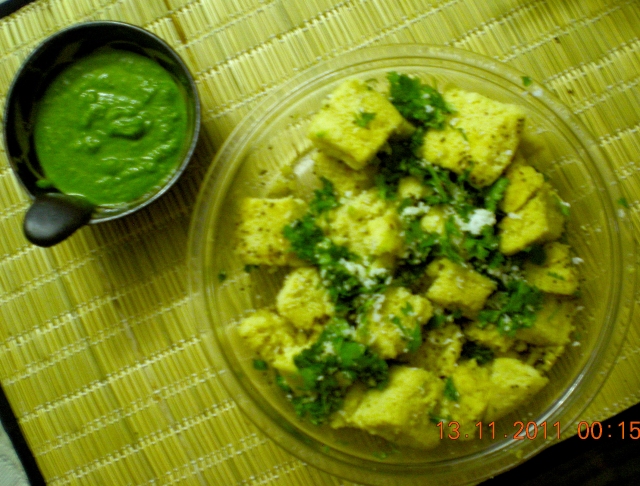
when i was thinking about what i should blog about after all these months, i kept thinking of sweet things – a cake maybe, or something to do with chocolate. but life has a way of changing your plans! :) last night, i had dhoklas and green chutney for dinner, and when i saw the little squares garnished with grated coconut and chopped corriander, with emerald-green chutney on the side, my mind was made up!

a popular gujarati dish, dhoklas come in varied forms. this one, known as ‘khaman dhokla’, is made from besan or chickpea flour. dhoklas are a light, delicious and versatile dish that are easy to make and can be served as a main or snack, at pretty much any time of day. and since it is steamed, it is also a healthy foodie option. all good things in one – ain’t that amazing? :)

couple of things to take note of: one, prepping your ingredients and utensils beforehand is very important. that’s because the version below (which is the ‘easy way out’ kind) depends on fruit salt to give the effect of instant fermentation to the batter. to let the batter sit for a while would mean that it would literally fizzle out – leaving you with hard dhoklas. the second thing is to use a flat plate or utensil with some depth that can fit into your pressure cooker (or steamer if you’re using one). if the plate is shallow, you won’t get the trademark springiness that is key to good dhoklas. and finally – this leans towards personal taste – please, please serve your dhoklas only with chutney – ketchup or chillli sauce just don’t cut it! so are you all set to get down to making some? :)

Ingredients:

For the Dhoklas:

1-1/2 level cups Besan or Chickpea flour
1 to 1-1/2 cups Water
3 tsp + 2 tbsp (for tempering) Oil
2 level tsp Enos Fruit Salt
1-1/2 tsp Lime juice
1 tsp Sugar
2 tsp Green chilli and Ginger paste (or to taste)
Salt
1/2 tsp Mustard
2 tsp White seasame seeds
1/2 tsp Asafoetida powder
5 Green chillies, minced
Fresh grated coconut and chopped corriander

For the Corriander Chutney:

1 cup corriander, chopped
little less than 1/2 cup Fried gram
2 Green chillies
1/2 tsp Sugar
1 tsp Lemon/Lime juice

Making the Dhoklas and Corriander Chutney:

Since the chutney is the easiest to make, you could start with it – just blend all the ingredients into the consistency you like and keep aside. 

Pour sufficient water into the pressure cooker, and keep it on low heat. Mix the besan, oil, water, lime juice, green chilli-ginger paste, sugar & salt, into a smooth batter without any lumps. Grease the plate in which you are going to steam the dhoklas with a bit of oil. If the water is not boiling yet, increase the heat and wait until the starts to boil. Sprinkle the Enos on the batter, sprinkle a tsp of water over the Enos, and quickly blend it water into the batter – do not whisk for too long. Pour the batter into the greased plate immediately, place it in the cooker, and close the lid (without adding the weight). Ensure that the heat/flame is not very high. After about 15 to 20 minutes, test to see if the dhokla is done by sticking a sharp knife into the center – if it comes out clean, it is done. Take out the dhokla, mark out the squares and keep aside.  

Make a weak sugar-water solution and keep aside. Heat the oil meant for tempering, and add the mustard seeds, sesame seeds, asafoetida and green chillies. Take it off the heat when the mustard seeds start to crackle. Sprinkle a couple of tablespoons of the sugar water on the dhoklas (especially in the ridges), then tip the tempered spices evenly all over. Garnish with the grated coconut and chopped corriander leaves. Cut the dhoklas into marked squares. Serve immediately with the chutney.

A Note To Say…

dear all,

its been close to 10 months since i last posted on this blog – whew! a very long break indeed. in these past months, i have been asked by some regular visitors on why there has been no updates, and if i plan to discontinue writing altogether. not a chance. this blog is still up and running.

there are good reasons behind why i haven’t been blogging for a while now, but they are a bit too long-winded and even a bit personal to be included here.

but all said, i agree – it has been far too long to let the blog lie idle. so i will put myself back on the routine and start posting again. so do keep a lookout! :) and for those who made it a point to ask me why i haven’t been updating – thank you, it feels nice to know that you care.

in the meanwhile, i have started a blog that talks about the restaurants and cafes i have visited – drop in on The Foodie Eateth and let me know what you think :)

Cheers!

Mangai Thokku (Raw Mango Pickle)

i am back home in Chennai (India) for a break – and boy am i loving it! :)  i get to eat my mum’s cooking every single day - after months of having to cook myself, this is a real treat! :)  and in the last couple of weeks i have been home, i have gotten to taste a variety of traditional dishes that i rarely make in my own kitchen – one of them being home-made pickles.

pickles are a staple in our household - pick any random day, and you will find atleast two or three varieties to choose from. while the major varieties of South Indian pickles revolve around the ingredients – from tiny raw mangoes to lemons to garlic - slight nuances in the proportion of salt and spices, and the method of cooking, can lead to interesting variations in flavour. however, since it usually entails a time-consuming process, the art of pickle-making has lost its appeal for many (me included). hence, i was a bit surprised when my mother announced one morning that she was planning to make mangai thokku or raw mango pickle - at home, from scratch. i had no idea of what was involved, but imagined it would take a whole day to complete. i was in for a pleasant surprise – the whole process took just about an hour! and the result was a flavourful, spicy pickle with a sour edge – perfect for a meal that involves rotis/rice and yoghurt! :) so, why not try making this at home some time? after all, the thrill of making your own can never be matched, right? :)
Read more

Almond Biscotti

its been a while since i last updated on this blog – and i have a very good reason for the long break. for the past couple of weeks, i haven’t been able to get any good clicks on my trusty 5-year-old digital camera. maybe its just me, but whatever i snap just doesn’t turn out well. and given just how important the visual element for food, i have been holding back from posting some rather nice recipes (if i may say so myself!) until i click something worthwhile. well, i have been thinking of getting a new camera for a while now - so maybe the gods are giving me a good enough reason to splurge on one! :)

so, i decided that while i may not be shooting anything new for the moment, i might as well clear some of my older folders. just a while back, i was browsing through my folders when i came across some clicks i had taken for some Almond Biscotti (by Tarla Dalal) i had baked a while back. i remember enjoying the biscuits with espresso, but for some reason or another, must have forgotten to blog about them. well, better late than never, right?

the name ”biscotti” derives from Italian which means “twice-cooked/baked”. the traditional procedure involves baking the rolled dough once, cooling it and then cutting it up and then baking it again. the result is the dry logs that can be stored for long periods of time. such food was apparently rather popular with the Roman Legions, and were a staple food during long journeys.

Tarla Dalal’s recipe below is a short-cut and requires you to bake the biscotti only once. despite the alteration in baking procedure, there is little change in their appeal – mildly sweet with the delicate crunch of almonds, these biscotti are sure to win you over! :) so bake some today and enjoy them with a hot cuppa - i know i am thinking of doing just that! :)
Read more

Cinnamon Rice Pudding

rice pudding is one of those dishes that is common to several cultures around the world: some make elaborate versions, some just boil stuff together, some garnish with rose water, raisins or nuts, while even others add in an egg yolk (or two) to make it a cream concoction. the rice pudding i am familiar with is from South India – typically made with cooked rice that is mixed with milk, sugar with crushed cardamom, and then boiled until it becomes a thick, sweet concoction. 

while this traditional version is a delectable dessert, i am not entirely fond of it for two reasons – one, it is often very sweet, which results in me feeling satiated after a couple of spoonfuls. and two, it is usually served warm/hot – and that is a no-no for me. so, i decided to modify the traditional version and come up with one that would suit my taste buds – with brown sugar for its subtle sweetness and cinnamon for flavour. the end result was delightful :)  it was light and  flavourful with the different tastes coming together in a nice blend – simply superb! :)

here’s a fun fact for all you rice pudding aficionados - did you know that August 9th is National Rice Pudding Day in the US? (and there’s more: the US boasts an entire list of food holidays – yes, food celebrations for every day of the year! check it out here!) 

*Photo from Getty Images
Read more